

News
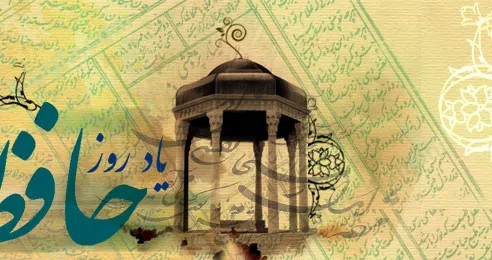
Commemoration of Hafez Day
 Oct 10, 2015
October 12, Commemoration of Hafez
Khwaja Shams al-Din Muhammad Shirazi, a poet and memorizer of the Quran, with the pen name Hafez, and known as Lisan al-Ghaib (the tongue of the unseen), is considered one of the greatest ghazal poets of Iran and the world. Hafez cannot be considered a one-dimensional poet, and his poetic thought cannot be interpreted and explained in only one pure aspect.
Hafez's poetry has diverse and varied dimensions, full of secrets, symbols, and questions about the truth of existence.
"In the morning, a cry came from the heavens, love said,
The angels, it seems, are memorizing Hafez's poetry."
Khwaja Shams al-Din Muhammad ibn Muhammad Hafez Shirazi is one of the greatest eloquent poets of Persian literature. Hafez was born in Shiraz in the early eighth century AH - around 727 AH. His father, Baha al-Din, was a merchant, and his mother was from Kazerun. After his father's death, young Shams al-Din stayed with his mother and, in his youth, worked as a baker. During this time, he became interested in acquiring knowledge and attended lessons and schools. After studying sciences, his life changed, and he joined the ranks of knowledge seekers and attended the lessons of the great scholars of Shiraz. He researched and studied the books of the great scholars of that time - such as Kashaf of Zamakhshari, Matal al-Anzar of Qazi Baydawi, and Miftah al-Ulum of Sakaki and the like. He also attended the lessons of Qavam al-Din Abu al-Baqaa Abdullah ibn Mahmud ibn Hasan Isfahani Shirazi.
Hafez - as his pen name suggests - had memorized the Quran and recited it in fourteen forms (seven readings). Hafez had a wife and children. In his ghazals, he has mentioned the death of one of his children:
"My heart, did you see that wise child,
What did he see in the curve of this colorful arch?"
"Instead of a silver tablet by his side,
The heavens placed a silver tablet on his head."
Hafez was not fond of travel, and because he had a special attachment to Shiraz, he did not leave Shiraz until almost the end of his life, and only once traveled to the city of Yazd, but due to boredom with Yazd and the people of Yazd, he returned to Shiraz:
"My heart was filled with the terror of Alexander,
I will pack my bags and go to the kingdom of Solomon."
He was also invited by Sultan Mahmud Dakani to go to Deccan, but he was caught in a storm in the island of Hormuz, and for this reason, he ended his journey without starting it and returned to Shiraz.
Hafez was a man of letters, knowledgeable in literary and religious sciences, and aware of the subtleties of wisdom and the realities of mysticism. His extraordinary talent in combining themes and bringing various rhetorical devices in his ghazals has made him the foremost poet of his time and even all Persian-speaking poets. He has welcomed the best ghazals of Rumi, Saadi, Kamal, Uwhadi, Khaju, and Salman, but his Divan is so full of long verses, excellent ghazals, and new themes that these imitations and influences seem small and insignificant among them. In addition, his high rank in high, wise, and mystical thinking and the power he had in expressing them in the most eloquent and melodious phrases have placed him as one of the greatest and most influential poets of Iran and made his Divan acceptable to both the elite and the general public.
This point should not be forgotten that Hafez's era coincided with the last stages of the evolution of the Persian language and Iranian Islamic culture. Therefore, his language and thought are closer to us compared to the masters before him, and for this reason, we understand Hafez more than the poets of Khorasan and Iraq and accept his words more.
Another point of his poems is his special attention to the use of various verbal and semantic industries, so that it is difficult to find a verse of his that is devoid of the role and design of industries. But his mastery in using words and industries is such that the industry has no effect on the ease of his speech and does not make his words artificial.
Contrary to Hafez's knowledge of mystical subtleties and his repeated references to mystical points, Hafez did not follow a particular path, but according to many, he himself went through the stages of self-cultivation and perfection and reached certain degrees.
His Divan of Kulliyat (Complete Works) consists of ghazals, several qasidas (odes), qit'as (fragments), rubais (quatrains), and two short masnavis (poems in rhyming couplets) entitled "The Wild Gazelle" and "Saqi-Nama" (Cupbearer's Song).
One of the noteworthy points about Hafez's Divan is the prevalence of "taking omens" - Tafal - from it, which is not a new tradition and has long been common among those familiar with his poetry, and since in every ghazal of Hafez's Divan, one can find a verse that suits the situation of the fortune-teller - with any interpretation and justification - he has been given the title "Lisan al-Ghaib".
Hafez, with his great poetic ability, expresses Quranic stories with subtle references in his poetry, but in reality, he is not a poet who narrates the story, but a capable poet who, with imagination and a deep understanding of many Quranic and social issues, presents them in the form of poetry.
Hafez's view of the world is a comprehensive one, in such a way that he expresses all material and spiritual issues with a sweet and firm expression and by using metaphor and simile, ambiguity and metaphor, and other literary industries.
When we are faced with a poet like Hafez, we are actually faced with a world full of subtlety and meaning. The semantic breadth in his poetry is such that everyone, from their own point of view, finds mental concepts appropriate to their own thinking in his poetry and offers a special opinion about him.
The mystical terms used in Hafez's poetry are the result of complete awareness and a correct understanding of meaning, but in reality, Hafez, before being a mystic, is a great and capable poet, and his poetic thought surpasses his mysticism. Hafez has a mystical and hopeful view, and mysticism in the true sense of the word is evident in his poems, and in his poetry, he always promises hope for a bright future, so that the audience, by studying his poems, achieves a kind of spiritual pleasure.
Hafez is a poet who, in the century of the dominance of asceticism, hypocrisy, and suffocation, has comprehensive and Rind (free-spirited) poetry and speaks of all the issues of the world with a subtle and Rind expression and always avoids showing off and hypocrisy, and poetry has a transcendent and idealistic aspect for him.
The poems of Hafez Shirazi are composed with inspiration from the pure teachings of Islam and the valuable concepts of the Quran, and all these poems contain beautiful and unique allusions and metaphors.
This famous poet of the land of Iran passed away in 791 or 792 AH.
May his soul rest in peace.
Oct 10, 2015
698 View count